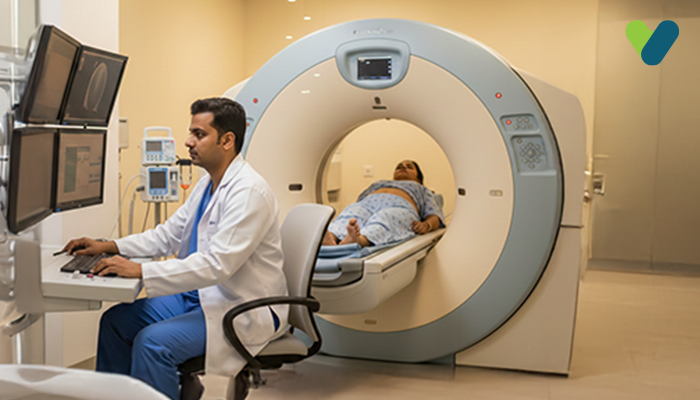

What is a CT PNS scan?
The computed tomography (CT) of the paranasal sinus (PNS) is a medical imaging technique that uses X-rays and computer technology to produce precise and detailed images of the sinuses. It is a non-invasive, reliable imaging method used to identify sinus inflammation or obstruction.What are paranasal sinuses?
The paranasal sinuses (PNS) are a group of air-filled cavities surrounding the nasal cavity. The paranasal sinuses are divided into four pairs:- Maxillary sinuses
- Frontal sinuses
- Ethmoidal sinuses
- Sphenoidal sinuses
What are the indications for a PNS CT scan?
- To diagnose inflammatory diseases, such as acute rhinosinusitis, chronic sinusitis , polyps and cysts, and mucoceles
- To detect a foreign body
- To determine the presence of malignancy
- For preoperative evaluation
- For guiding surgical procedures
- To detect any mass or defect in the sinuses
- To diagnose birth defects
- To assess trauma or injury
- To determine the cause of repeated bleeding from the nose
How to prepare for the CT PNS scan?
- Dress in comfortable, loose clothing.
- Remove all metallic objects as they can hinder with CT imaging.
- When you enter the scanner, the X-ray beam will rotate around you. The X-ray beam will not be visible to you.
- Do inform the doctor about the medications being taken and about any allergies that you may have.
- Side effects could be aggravated by a recent ailment or even some other medical event.
- Women should notify the doctors whether they are pregnant before the procedure.
How is the CT PNS scan performed?
- You may be asked to change into a hospital gown.
- You will be instructed to lie down on a table that slides through the centre of the CT scanner. You can either lay down on your back or face down with your chin raised.
- When you enter the scanner, the X-ray beam will rotate around you. The X-ray beam will not be visible to you.
- A computer generates the separate images of each body region. These are known as slices. The pictures can be saved, viewed on a computer screen, or printed on a film. By stacking these slices together, a 3-dimensional view of the body can be created.
- Since movement can cause blurred images, you must remain still during the exam. You might be instructed to hold the breath for brief periods of time. In order to keep you still throughout the procedure, pillows and straps may be used.
- The scanning procedure is expected to last about 30 seconds. The entire procedure should take no more than 15 minutes.
What are the risks associated with a CT PNS scan?
The following are the risks of a CT PNS scan:- There is always a minor possibility of developing cancer from excessive radiation exposure. The advantage of an accurate diagnosis, on the other hand, far exceeds the risk of CT scanning.
- PNS scanning is generally not advised in pregnant women until absolutely necessary.
- If the contrast medium is given intravenously, mothers should refrain from feeding their babies for 24 to 48 hours.
- An allergic reaction to iodine-containing contrast material is possible. However, the reaction is extremely rare.