
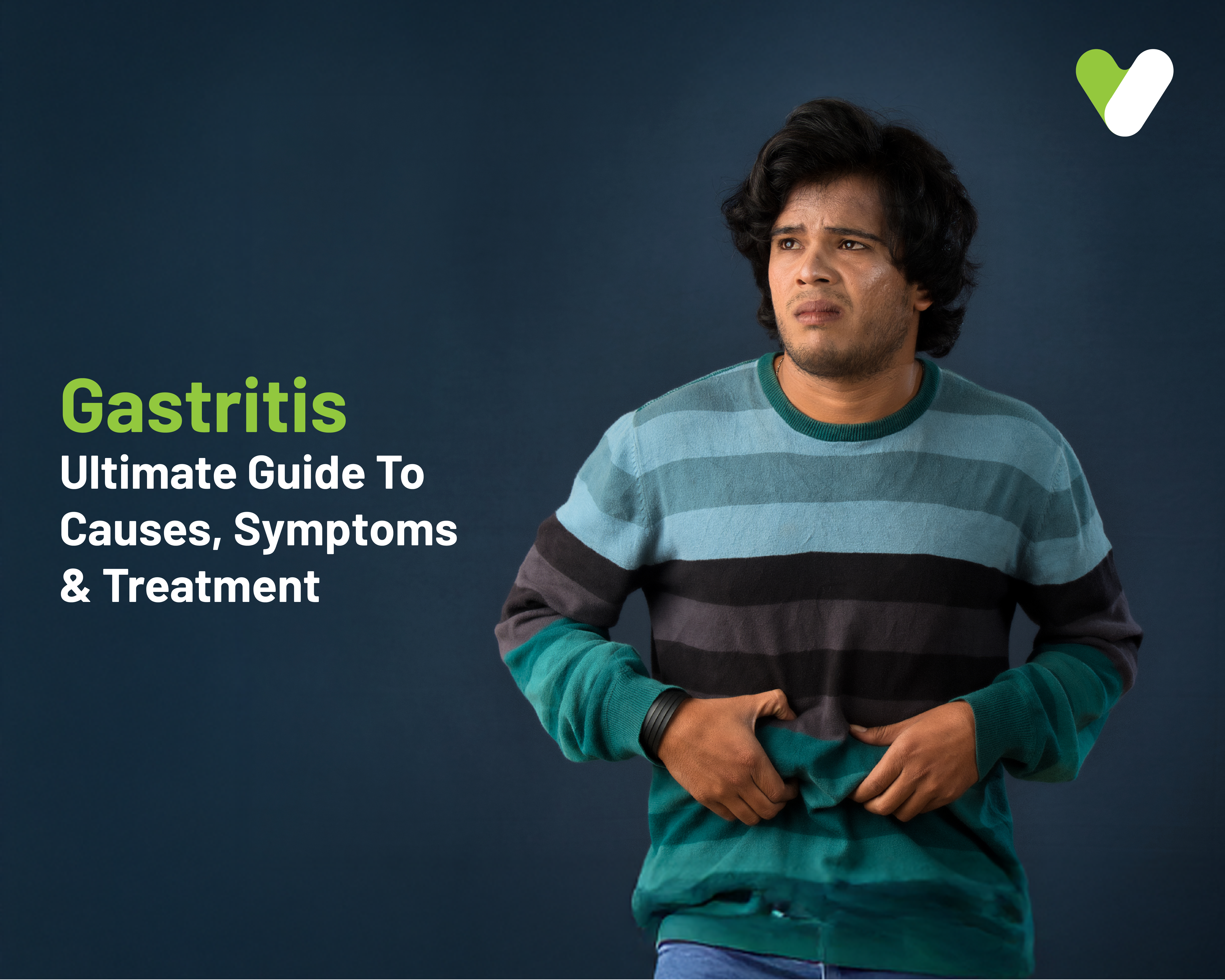
Sarah, a 35-year-old marketing executive, finally had to stop ignoring the gnawing in her upper abdomen. What started as occasional discomfort after meals had escalated into persistent pain, nausea, and loss of appetite. She was soon to enter into the early stages of a condition affecting millions around the globe: gastritis. Gastritis is an inflammation of the stomach lining. Generally speaking, people tend to assume it is rather rare, but studies have revealed that from 50% of the world's population, nearly everyone at some time in their lifetime will have a kind of gastritis, although many people are never diagnosed. In India, every 3rd person out of 826 suffers from Gastritis. These statistics pin down the point of the need to know about this widespread disease.
What Is Gastritis?
Gastritis is an inflammation of the protective lining of the stomach. It can be acute, appearing suddenly, or chronic, arising gradually. In all cases, it can bring a group of uncomfortable symptoms that, if left untreated, can lead to potentially serious complications. The inner lining of the stomach, normally protected by a coating of mucus, can become compromised and thus become vulnerable to inflammation and, in some instances, erosion of the stomach lining.Gastritis Causes
There are several reasons that gastritis arises. These include:- Helicobacter pylori infection: Helicobacter pylori is considered to be the leading cause of gastritis throughout the world.
- Recurrent use of NSAIDs: Analgesics such as aspirin and ibuprofen irritate the stomach lining.
- Alcoholism: Alcohol eats into the mucous lining that protects the stomach. Pressure/Psychological: Stomach acids build up and inflammation begins under intense pressure.
- Autoimmune disease: At times, the immune system of the body attacks the stomach lining.
- Bile reflux: Bile reaching the stomach from the bile duct damages the stomach.
Gastritis Symptoms
The symptoms of gastritis may vary from person to person; they may include:- Gnawing or burning pain in the upper abdomen
- Nausea and vomiting
- Loss of appetite
- Bloating, feeling full, and nausea
- Indigestion
- Dark-colored stools (indicating GI bleeding)
Gastritis Diagnosis
Gastritis is primarily diagnosed by following the following procedure:- Medical history and physical exam: The doctor will will ask for the history of symptoms, and a physical examination will be done
- Blood tests: For the diagnosis of anemia or H. pylori infection.
- Stool test: To analyze for blood in the stool or H. pylori.
- Upper endoscopy: A thin tube with a camera passed through the mouth to view the stomach lining.
- Biopsy: During endoscopy, sometimes tissue samples are taken for further examination.
Gastritis Treatment
In the treatment, these plans try to minimize inflammation and treat the cause. The following are the treatments available:Medications:
- Antacids to neutralize stomach acid
- Proton pump inhibitors or H2 blockers to decrease the amount of acid produced
- Antibiotics if H. pylori is detected
- Avoid foods that trigger acidity, especially hot, acidic, or fatty foods
- Increase in small and frequent meals
- (Limit alcohol or refrain from alcohol intake)
- Smoking cessation
- Stress management
- Probiotics to aid good gut flora
- Herbal teas can be either chamomile or ginger
Gastritis and Diabetes
There is an interesting link between gastritis and diabetes. Research has shown that diabetics, especially those whose glycemic control is compromised, are at a greater risk of developing gastric inflammation. It can be thought that the above-mentioned association may be due to the following factors:A higher susceptibility to H. pylori infection among diabetics Diabetic neuropathy leads to malfunction in the stomach Altered immunity in diabetes
For those who have both conditions, a high index of suspicion must exist for both gastritis and diabetes diagnoses and treatment so that they can be treated appropriately. Also Read : Preventing Gastric Ulcers using Ayurvedic Treatment
When to see a doctor for Gastritis
Visit your doctor if you experience: Abdominal pain that lasts more than a week- You experience frequent nausea and vomiting
- You find it hard to swallow
- Unexplained weight loss
- Your stools appear black or tarry. This is an indication of gastrointestinal bleeding.
- You experience indigestion that does not improve with the OTC medications.
References :
- Sugano K, et al. (2015). Kyoto Global Consensus Report on Helicobacter pylori gastritis. Gut, 64(9), 1353-1367. https://pubmed.ncbi.nlm.nih.gov/26187502/
- Laxmi Narayan Dash, et al. (2024). Prevalence and Contributing Factors of Gastritis in tertiary care hospital : Study from Eastern India. European Journal of Cardiovascular Medicine [Internet]. https://healthcare-bulletin.co.uk/article/title-prevalence-and-contributing-factors-of-gastritis-in-tertiary-care-hospital-study-from-eastern-india-2298/
- Wang F, et al. (2011). Diabetes mellitus and risk of gastric cancer: a systematic review and meta-analysis. European Journal of Gastroenterology & Hepatology. https://journals.lww.com/eurojgh/abstract/2011/12000/diabetes_mellitus_and_risk_of_gastric_cancer__a.6.aspx
- Gastritis. Harvard Health Publishing, Harvard Medical School[Internet]. https://www.health.harvard.edu/digestive-health/gastritis.
- Everything you need to know about gastritis. MedicalNewsToday[Internet]. https://www.medicalnewstoday.com/articles/309046.