What Is LASIK Surgery?
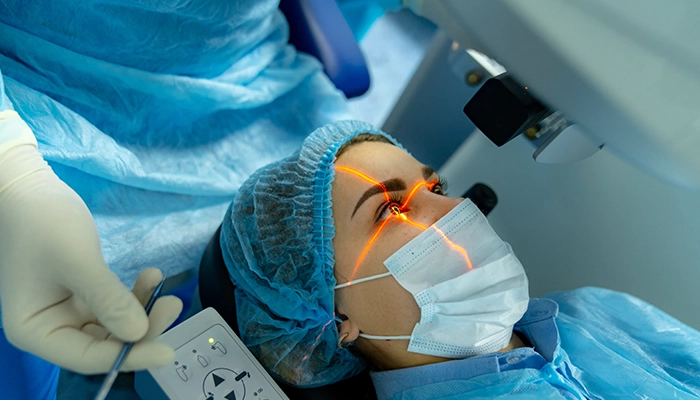
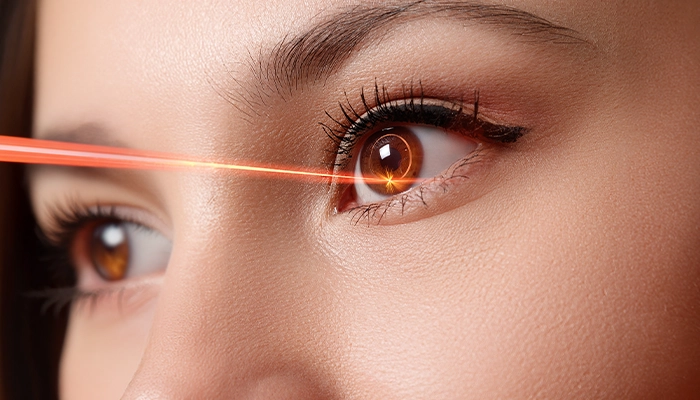
LASIK is a refractive surgery used to remove glasses by correcting certain vision problems like myopia, hypermetropia, and astigmatism. In LASIK, vision is corrected by reshaping the cornea, the transparent front surface of the eye. When the cornea does not bend light properly onto the retina, it causes blurred vision. In such cases, glasses are used to correct vision. LASIK surgery uses a highly precise laser to reshape the cornea so light focuses correctly, allowing clearer vision without glasses or contact lenses.
What are the different types of LASIK Surgery?
All-laser LASIK: It is also known as bladeless LASIK. Unlike traditional LASIK, which uses a microkeratome blade to create the corneal flap, all-laser LASIK uses a femtosecond laser.
This laser allows for greater precision in creating a flap with consistent thickness and a lower risk of complications.
In this type, the laser makes the procedure less invasive and improves the surgeon’s ability to tailor the flap to the individual’s eye anatomy.
This technology is safe because it leverages the latest advancements in eye surgery to improve safety and outcomes.
SMILE LASIK: SMILE is a one-step, 3rd-generation vision correction procedure and a minimally invasive procedure. During a SMILE procedure, the surgeon uses computer-guided, highly focused laser light to cut a tiny incision in the cornea and will use it to remove a small piece of corneal tissue called a lenticule. The surgeon removes this lenticule through a small, laser-made incision, reshaping the cornea to correct vision.
SMILE Surgery is a very comfortable vision correction procedure. Many young patients prefer SMILE because it is very comfortable. It is virtually painless.
Epi LASIK: Itis an advanced laser vision correction technique. It is particularly suited for individuals with thin corneas, dry eyes, or active lifestyles who must avoid flap-related complications.
Epi LASIK is a surface ablation procedure in which only the outermost epithelial layer of the cornea is gently separated using a mechanical device called an epi-keratome. This approach avoids alcohol and does not involve cutting a deep corneal flap.
Once the epithelium is lifted, an excimer laser reshapes the underlying corneal surface to correct refractive errors. The epi LASIK procedure is less invasive to the corneal structure while still delivering accurate visual correction.
How Safe Is LASIK Surgery in India?
Published research shows satisfaction rates for LASIK surgery are above 95 percent.
Most patients may experience some mild effects in the first few days, including dry eye, light sensitivity, and halos around lights at night. These are usually temporary effects and settle on their own or with prescribed medication over time.
Less common outcomes include minor under-correction that may need an enhancement after a few months. Serious complications are rare and include ectasia and infections.
Is LASIK Surgery Permanent?
Yes. The corneal reshaping done during LASIK is permanent. However, one may still need specs in the future.
Age-related changes can still affect vision over time.
Presbyopia typically develops after 40, and cataracts may occur after 55 to 60. These happen in the natural lens, not the cornea, and are completely unrelated to the LASIK procedure, but one may need specs.
Safety and Recovery After LASIK Surgery
Most patients notice their vision improving quite quickly after specs removal surgery. Vision usually begins clearing within a few hours, but it’s important to give your eyes proper rest and avoid screens, rubbing your eyes, or exposure to dust and bright light.
In the first 24 hours, it’s normal to experience mild blurriness, watery eyes, or some light sensitivity. Vision rapidly clears after this.
Over the next couple of days, vision continues to improve, and many people with desk jobs can resume work within 72 hours of surgery.
Activities like swimming, contact sports, or eye makeup should still be avoided for a few weeks till your doctor gives you the go-ahead.
Some patients may notice temporary halos around lights at night in the early weeks, which usually settle as the cornea heals.
Most people achieve stable vision within a few weeks, with follow-up visits helping the doctor ensure everything is healing well.
Bottomline:
LASIK procedures offer a powerful solution for individuals seeking independence from glasses or contact lenses. LASIK success depends not only on the technology, but also on the pre-surgical assessments and post-surgical care.
For many people, LASIK surgery is a life-changing event that gives them the joy of more clear vision and the freedom to engage in activities without glasses or contact lenses.
Disclaimer: This article is meant for informational purposes only and must not be considered a substitute for professional advice.