
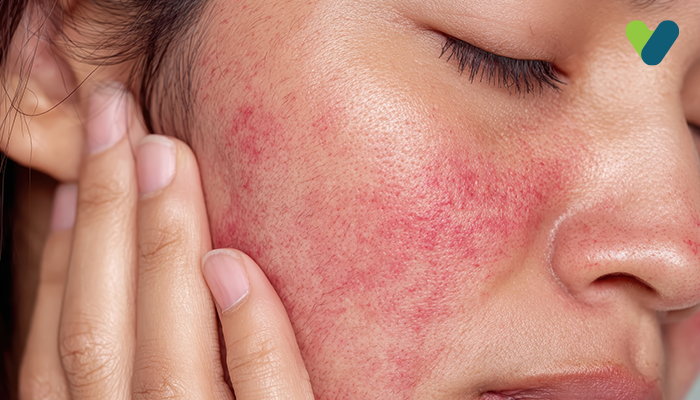
What is an angiofibroma?
An angiofibroma is a benign or non-cancerous tumor. It is made up of fibrous connective tissue and blood vessels. When you see the phrase “angiofibroma meaning”, you can interpret it as a growth that is composed of vascular and fibrous tissue. “Vascular” refers to the “angio-” part, while “fibrous” refers to the “-fibroma” part.
There are different types of angiofibromas, depending on where they are located and with which conditions they are associated. For instance, facial angiofibromas appear on the face, especially the cheeks and nose. “Angiofibroma nose” is typically the phrase used to refer to angiofibromas that have appeared around the nose or in the nasal region. The term may also be used when discussing a more serious variant called “nasopharyngeal angiofibroma”, which occurs in the nasal cavity. Facial angiofibromas typically show up as small, firm, dome-shaped, little bumps on the central face; this region covers the cheeks, nose, and sometimes, the nasolabial folds.
So, angiofibroma is mostly benign in nature. It manifests as a small, reddish bump on the face. In this blog, we will cover angiofibroma causes, angiofibroma symptoms, the diagnostic criteria for angiofibroma, and angiofibroma treatment.
Who gets angiofibromas?
The occurrence of angiofibromas depends on the type of angiofibroma and the underlying health conditions that cause it. Let’s break this down:
Facial Angiofibroma
This type of angiofibroma often appears in people with certain genetic syndromes. For instance, those with Tuberous Sclerosis Complex (TSC) develop multiple facial angiofibromas. Birt-Hogg-Dube Syndrome and Multiple Endocrine Neoplasia Type 1 have also been linked to facial angiofibroma. Cutaneous angiofibromas developed even without these syndromes, especially around the nose. They can occur as isolated lesions in adults.
Nasopharyngeal Angiofibroma
This type is also called juvenile nasopharyngeal angiofibroma. It occurs almost exclusively in adolescent males, typically aged 10 years to 25 years. It is extremely rare; only about 1 in 150,000 to 1 in 1,500,000 people are affected. It accounts for a tiny fraction of head and neck tumours.
You might see facial angiofibromas more broadly, especially in people with certain genetic conditions. Nasopharyngeal angiofibroma is seen almost exclusively in younger males.
What causes angiofibromas?
The most common angiofibroma causes include overproduction of collagen, fibroblasts, and blood vessels. The exact trigger is unknown. They are often associated with underlying health conditions. Let’s explore what causes angiofibromas and the mechanisms behind them.
For facial or cutaneous angiofibromas
- According to dermatology sources, they are caused by a local overgrowth of collagen, fibroblasts (the connective tissue cells), and blood vessels.
- In the setting of TSC (tuberous sclerosis complex), mutations in the TSC1 or TSC2 genes lead to dysregulation of cell growth, which may contribute significantly to the development of angiofibromas.
For nasopharyngeal angiofibromas
- The exact cause is not fully understood, but many mechanisms have been proposed. Hormonal influences, especially androgens, are thought to play a role because of the strong male predominance.
- Some experts suggest embryologic remnants, such as branchial arch remnants or abnormal vascular tissue, as a basis.
The cause for angiofibromas is multifactorial. It stems from genetics, hormonal factors, vascular causes, and anatomical factors that likely interplay.
Therefore, when someone asks about angiofibroma meaning in terms of cause, the answer is that while the term defines the histology (blood vessels + fibrous tissue), the cause may vary significantly depending on site and context.
What are the complications of angiofibromas?
When we ask about the complications of angiofibromas, we must differentiate between the superficial or skin type and the deeper or nasal type.
Facial angiofibromas
- Facial angiofibromas complications are usually cosmetic in nature. Many remain stable and cause no major medical issues. However, the appearance can lead to psychological/social distress because of visibility.
- If large or numerous, they may require dermatologic, surgical, or laser treatment.
- In people with associated disorders (TSC, etc), the angiofibromas may be a marker of a broader problem with possible kidney, heart, and brain involvement. So, that is a systemic concern.
Nasopharyngeal Angiofibromas
This type has more serious potential complications because:
- The tumour is highly vascular; it can cause significant nosebleeds.
- It may cause nasal obstruction & difficulty breathing through the nose.
- With growth, the tumour may extend into sinuses, eye sockets, skull base, and even the brain. This increases the risk of serious complications, such as vision loss, hearing loss, and intracranial extension.
- The vascular nature means surgery carries bleeding risks.
While facial angiofibromas might mostly impact aesthetics and warrant dermatologic care, an angiofibroma nose (nasopharyngeal) can have significant local mass effect and bleeding risks, and thus demands timely diagnosis and management.
How are angiofibromas diagnosed?
For angiofibroma diagnosis, we look at clinical features, imaging, histology, and, where appropriate, genetic testing.
Facial Angiofibromas
- These are often diagnosed by physical exam: firm, small dome-shaped bumps on the central face (nose & cheeks) consistent with the description of multiple facial angiofibromas.
- A dermatologist may perform a biopsy of the lesion to confirm the histology: spindle or stellate cells, dilated thin-walled blood vessels in the dermis, and fibrous stroma are common characteristics.
- If a syndromic condition, like TSC, is suspected, further work-up may be recommended. This includes genetic testing, imaging of nearby organs, and more.
Nasopharyngeal Angiofibroma
- The diagnosis typically involves imaging studies rather than an immediate biopsy (because of bleeding risk). For instance: CT scan, MRI, and sometimes angiography to look at the vascular supply.
- Endoscopic nasal examination may reveal a reddish-purple mass at the back of the nasal cavity.
- A biopsy may be avoided initially because of the risk of significant bleeding, given the tumour’s vascularity.
Diagnosing angiofibroma involves linking the clinical presentation with imaging and, sometimes, biopsy, while being cautious about potential bleeding in nasal cases.
What is the diagnosis for angiofibromas?
We’ve spoken a lot about the diagnosis of angiofibromas above. Let’s take a look at angiofibroma diagnosis from a more clinical perspective, or how a clinician arrives at the diagnosis.
History and examination
- For facial angiofibromas: noticing the typical location (nose/cheeks) and appearance (firm, small, dome-shaped papules).
- For angiofibroma nose: symptoms such as recurrent nosebleeds, nasal obstruction, and possibly facial swelling.
Imaging
- CT scan and/or MRI reveal a vascular mass in the posterior nasal cavity, possibly with involvement of sinuses or skull base.
- Angiography may identify feeding arteries and help in planning.
Biopsy or Histopathology
- For cutaneous angiofibromas, there are morphological features, like fibrovascular tissue, spindle or stellate cells, and thin-walled vessels.
- For nasal type, biopsy is often deferred until surgical planning, due to the risk of hemorrhage.
Genetic Evaluation
- If facial angiofibromas appear in a pattern that suggests a syndrome, evaluation for conditions like TSC may be warranted.
Making The Diagnosis
Once the findings align, the physician can make the diagnosis of angiofibroma. The key is distinguishing the type and understanding the implications: a facial angiofibroma may be a benign isolated finding or a marker of a genetic syndrome; a nasopharyngeal angiofibroma may require more urgent management because of bleeding risk and invasive potential.
What is the treatment for angiofibroma?
The best way to treat an angiofibroma depends heavily on the type, location, number of lesions, symptoms, and underlying causes or conditions. Let’s break down the angiofibroma treatment according to its types.
Treatment of facial angiofibroma
Many lesions are asymptomatic and purely cosmetic; in such cases, treatment might not be necessary other than periodic observation. For lesions that are bothersome (large, numerous, bleeding, affecting appearance), treatment options include:
- Laser therapy, where they use a pulsed dye laser to target the vascular component of these benign bumps.
- Surgical excision or punch excision, where they target isolated lesions.
- Other treatment methods include cryotherapy, dermabrasion, topical agents, etc. Topical agents are still under further research as an effective treatment for facial angiofibromas.
If the angiofibromas are part of a syndrome (e.g., TSC), management may also involve the broader condition and systemic therapy (for example, mTOR inhibitors), though the direct use specifically for angiofibromas is still under study.
Nasopharyngeal Angiofibroma
The risk of bleeding and potential for local extension is high, so the approach here is more aggressive:
- Preoperative embolization may be done to reduce the blood supply to the tumour and minimize intraoperative bleeding.
- Surgical resection is the primary treatment option. Many centres now use endoscopic endonasal approaches, which are minimally invasive through the nose, when feasible.
- Postoperative monitoring for recurrence is important. In some cases, radiotherapy or medical therapy may be considered if total resection is not possible.
The best treatment for a given case of angiofibroma needs individualization. For a small aesthetic lesion on the nose (facial angiofibroma) with minimal impact, perhaps no action or simple excision/laser may be required. For a large, symptomatic, vascular tumour in the nasal cavity (angiofibroma nose), there may be a requirement for multidisciplinary ENT, radiology, and surgical planning with embolization, in addition to surgery.
Key Takeaways
- The phrase angiofibroma meaning refers to a benign tumour composed of blood vessels (angio-) and fibrous tissue (fibroma).
- Facial angiofibromas are common in certain genetic conditions (e.g., TSC) and typically present as firm, dome-shaped papules on the nose/cheeks.
- The term angiofibroma nose often refers to the nasopharyngeal form, a rare but potentially serious benign tumour located in the nasal cavity/back of the nose, almost always in young males.
- Causes vary by type: local overgrowth of fibrovascular tissue for facial lesions; hormonal, vascular, and embryologic factors for nasal lesions.
- Complications: facial lesions are mostly cosmetic; nasal lesions can cause nosebleeds, nasal obstruction, local invasion, and bleeding risk.
- Diagnosis: for facial lesions, exam and biopsy; for nasal lesions, imaging, endoscopy, possibly biopsy, but with caution.
- Treatment: depends on type, cosmetic or dermatologic treatments for facial; embolization + surgical resection for nasal forms.
- Being non-cancerous does not mean benign in effect; severity depends on location and size.