
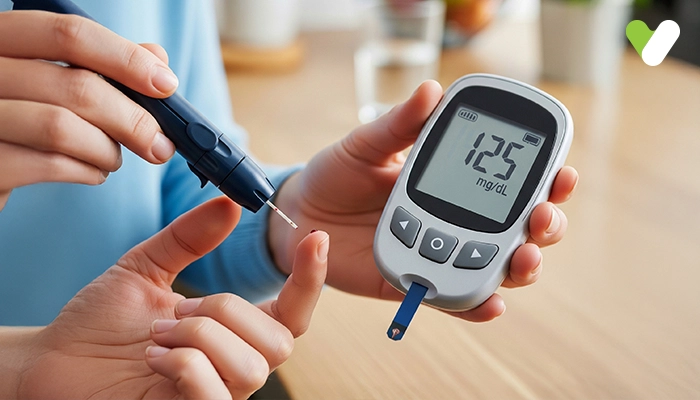
Early and correct diagnosis of Type 1 diabetes is crucial in the management of blood sugar levels, complications, and long-term health outcomes. A Type 1 Diabetes test assists in overcoming the diagnosis of whether the immune system of the body is attacking insulin-producing beta cells located in the pancreas.
Type 1 diabetes does not come out of nowhere, as Type 2 Diabetes does, and lifestyle factors do not cause it. Hence, this is why timely blood tests for diabetes are vital in distinguishing it from other types of Diabetes and initiating the right treatment.
This blog will discuss the various Type 1 diabetes tests in detail, such as the glycated haemoglobin A1C test, the fasting plasma glucose test, and the random blood sugar test and how each of the tests is prepared, interpreted, and clinically significant.
Also read: Know The Early Signs & Symptoms Of Diabetes
What is Type 1 Diabetes?
Diabetes type 1 is an autoimmune disease in which the immune system erroneously kills insulin-producing beta cells in the pancreas. Low levels of insulin will cause glucose to fail to get into cells as a source of energy, causing an increase in blood sugar. Manifestation of the condition is normally found in childhood or adolescence, but also in adults; this is referred to as latent autoimmune diabetes in adults (LADA).
The symptoms can be sudden, and they can be excessive thirst, frequent urination, fatigue, blurred vision, and unintentional weight loss. Because these symptoms may be similar to other metabolic diseases, a Type 1 diabetes test is essential for proper diagnosis.
Intention behind the Type 1 Diabetes Test
A Type 1 diabetes test is mainly conducted to determine the level of blood sugar and response of the body to insulin. It also assists in differentiating Type 1 diabetes from Type 2 diabetes and other types of diabetes, such as monogenic diabetes or secondary diabetes.
Physicians prescribe the tests to the patients in case of the emergence of such symptoms as excessive thirst, frequent urination, fatigue, and unjustified loss of weight . Timely diagnosis of diabetes will result in intervention and successful management of diabetes and decreased risks of diabetic ketoacidosis and chronic complications such as neuropathy or renal disease.
Also read: Diabetes Mellitus - Origin & History
Test types of Type 1 diabetes
Type 1 diabetes can be confirmed using a number of laboratory and clinical tests. Each of the tests has its own diagnostic purpose and could be combined to reach a definitive diagnosis.
Glycated Haemoglobin (A1C ) Test
The glycated haemoglobin A1C test is a test that indicates the average blood sugar levels in the last 2, 3 months. It measures the proportion of haemoglobin molecules in the blood to which the glucose molecules have been attached.
- Normal A1C: Below 5.7%
- Prediabetes: Between 5.7% and 6.4%
- Diabetes: 6.5% or high on two different tests.
One of the best uses of the A1C test is due to the fact that it gives one a long-term picture of the glucose control as opposed to daily tests, where the glucose level is measured at a point in time. Though it is popularly utilized in the diagnosis of Type 1 and Type 2 diabetes, it needs an extra confirmation with other blood tests in suspected cases of autoimmune diseases.
Also Read: What Is HbA1C? Know Everything
Fasting plasma glucose (FPG) Test.
The fasting plasma glucose test is a test that is done on the blood sugar after fasting for at least 8 hours. It dictates the effectiveness of the body to maintain blood sugar levels when there is no food.
- Normal: Below 100 mg/dL
- Prediabetes:100 to 125 mg /dL
- Diabetes 126mg/ dL and above twice.
The fasting plasma glucose test is among the most valid initial detectors of the diabetes condition in combination with the A1C test or the antibody test of Type 1 diabetes.
Random Blood Sugar Test
Random blood sugar test may be conducted at any time of the day, not necessarily before or after meals. A reading of 200 mg/dL and above, and other symptoms like excessive urination or thirst, are normally found to be indicative of diabetes.
This test is commonly used as the initial screening procedure for patients who report complaints with acute symptoms. Due to its convenience and rapidity, it is often employed in the emergency environment where Type 1 diabetes or diabetic ketoacidosis is suspected.
Autoantibody Tests
Autoantibody tests are also necessary in the confirmation of Type 1 diabetes since it is an autoimmune disorder. These are tests that detect the existence of autoantibodies that antagonise the insulin-producing cells. Typical autoantibodies tested are :
The antibodies of GAD65 (glutamic acid decarboxylase) are also present.
- IA-2 antibodies (islet antigen- 2)
- ZnT8 (zinc transporter 8) antibodies.
- Insulin autoantibodies ( IAA)
The presence of one or more of such antibodies will prove that there was autoimmune destruction of pancreatic cells, thus distinguishing Type 1 diabetes as opposed to Type 2 diabetes.
C-Peptide Test
The C-peptide test is used to determine the amount of insulin that the pancreas is producing. A low or non-detectable concentration of C-peptide is characteristic of Type 1 diabetes, whereas a normal or high concentration is characteristic of Type 2 diabetes.
C-peptide testing is commonly performed with the assistance of autoantibody testing to obtain a complete image of pancreatic functioning.
Other Diagnostic Assessments.
Physicians can request more tests in some clinical scenarios to confirm Type 1 diabetes or assess complications related to it:
- Ketones ( to exclude diabetic ketoacidosis) urine test.
- Electrolytes panel to evaluate dehydration or acidosis.
- In case of suspected monogenic diabetes, genetic testing.
- Such assessments make sure that there is a proper distinction of different types of diabetes and develop treatment plans.
Also Read: Borderline Diabetic - All You Need To Know
How to Prepare to have a Type 1 Diabetes Blood Test.
Depending on the kind of test to be conducted, preparation is dependent. For example:
No food or drink (except water) should be taken during the 8 - 12 hours before the fasting plasma glucose test.
Only the random blood sugar test and the A1C test do not need fasting.
Patients are supposed to notify their health practitioner about the drugs they use since certain drugs can influence the levels of glucose.
Normal hydration and avoiding high-sugar diets or drinks before testing are one of the measures to guarantee correct results.
Also read: Comprehensive Guide To Sugar Medicine For Diabetic Patients
Diabetes Type 1 Results Interpretation.
Results interpretation should always be carried out by a competent medical worker.
A positive autoantibody test with high levels of blood glucose on fasting or random blood tests is strongly indicative of Type 1 diabetes.
Positive antibodies in normal glucose would indicate that one may develop diabetes in the future.
These tests can be used at an early stage to enable physicians to start insulin treatment as early as possible, which can help to control glucose levels and to avoid such severe complications as diabetic ketoacidosis.
Compared to Type 2 Diabetes Tests, the Type 1 Diabetes Test is more accurate and precise.
The difference between Type 1 and Type 2 diabetes and diagnostic characteristics
The genetic diagnosis of Type 1 diabetes is pancreatic beta cell destruction that is immune-mediated and requires antibody, C-peptide tests.
Diabetes type 2 is caused by insulin resistance, insulin insufficiency; it is mostly diagnosed with the help of the A1C, FPG, or oral glucose tolerance tests.
As such, although the two conditions are characterized by a high sugar level, the Type 1 diabetes test only shows autoimmune markers that characterize the disease.
How and When to Be Tested for Type 1 Diabetes
Every person with typical signs of diabetic symptoms- particularly the children and teenagers- must take a Type 1 diabetes test as soon as possible.
It is especially necessary to test when:
The family has Type 1 diabetes.
The individual loses weight fast, becomes very thirsty or urinates frequently.
The level of blood glucose is unpredictable.
Early diagnosis, insulin treatment and prevention of diabetic crisis are ensured by timely testing.
Also read: Top Causes of Diabetes & its Prevention
Difficulties with the Diagnosis of Type 1 Diabetes
Type 1 diabetes diagnosis among adults may be complicated because of its similarity with Type 2 diabetes at the early stages of development. The misclassification may delay the insulin treatment, resulting in poor glycemic control and risk of ketoacidosis.
The accuracy of diagnosis is provided by thorough examination using the glycated haemoglobin A1C test, a fasting plasma glucose test, C-peptide, and autoantibody tests.
Also read: Diabetic Diet: Discover The Best Food For Diabetic Patients
Monitoring After Diagnosis
The diagnosis of Type 1 diabetes should be followed by regular checkups in the form of A1C tests, fasting blood glucose tests and ketone checks. These assist in monitoring the effectiveness of the treatment and early detection of complications.
The A1C test should be conducted on a regular basis of every 3 months to ensure that the patients are in control of their glucose. Regular fasting plasma glucose tests can also be ordered in order to adjust the insulin dosage.
Prevention and Clinical Significance.
Even though Type 1 diabetes cannot be prevented, early diagnosis with the help of reliable testing can be greatly improved. Early intervention measures and involvement in prevention trials could be offered through detecting autoantibodies in at-risk people.
Type 1 diabetes testing aids in clinical aspects, in particular:
- Timely insulin therapy.
- Prevention of ketoacidosis
- Individual patient care.
- Fewer long-term complications.
The above advantages underscore the importance of early diagnosis in the management of diabetes.
The Extended Importance of Tests at an Early Age
Early Type 1 diabetes diagnosis not only avoids emergencies such as ketoacidosis, but it also leads to a better quality of life because of timely care provision. Children and adults diagnosed in early stages process more effectively the insulin therapy and lifestyle changes, minimising the complications in the long-term, including neuropathy, retinopathy, and cardiovascular disease.
In addition, regarding a public health issue, increasing the knowledge on the significance of a Type 1 diabetes test can contribute to community-based screening programs, especially in a population that has a genetic predisposition. Early detection may also open the gate to involvement in clinical trials/studies on immune modulation or pancreatic beta-cell preservation, which would possibly revolutionise the future of management of diabetes.
Finally, the full testing, which consists of glycated haemoglobin A1C test, fasting plasma glucose test, random blood sugar test, and autoantibody test is the foundation of a successful Type 1 diabetes diagnosis. It balances the clinical accuracy with the timely action, making sure that the individuals are not merely treated but provided with tools and knowledge on how to manage their condition successfully.
Also read: Blood Sugar Levels Without Diabetes
Conclusion
Effective diabetes management depends on the timely and accurate Type 1 diabetes testing. The improvement of diagnostic techniques, such as A1C testing and the autoantibody tests ,enables early diagnosis and introduction of insulin treatment to physicians and long-term control.
Understanding each test’s role helps patients and clinicians make informed decisions, ensuring that diabetes care remains proactive, precise, and life-saving.