
Diabetes mellitus is a persistent metabolic disease that influences the use of glucose in the body. Incompetence or insufficiency of insulin causes the body to burn fat instead of glucose in cells, as the body cannot easily enter the cell with insulin. The ketone bodies that are produced by this fat metabolism may lead to diabetic ketoacidosis (DKA), a severe, life-threatening emergency in excess quantities. A diabetic ketoacidosis test is vital as it can be used to early detect and avoid complications and inform about medical intervention promptly.
This is a detailed information guide on what the DKA test is, the mechanism, the parameters measured and the reason why early detection of abnormal blood ketones can save lives.
Also Read: Diabetes: Meaning, Types, Symptoms & Treatment
What Is a Diabetic Ketoacidosis (DKA) Test?
A diabetic ketoacidosis analysis is a diagnostic test used to identify the accumulation of the ketone bodies and identify metabolic acidosis in patients with diabetes. It may usually be a blood test of ketones with or without a urine test or an acetone blood test in order to ascertain the nature and levels of ketones circulating in the blood.
Also Read: Top 11 Diabetes Signs & Symptoms You Should Know
The test is also used in clinics to assess the level of blood pH, bicarbonate, volume of anion gap and glucose to identify the intensity of the DKA. All these tests are used to determine whether the metabolism of the patient has changed so that it is no longer carbohydrate-based, but rather, fat-based, leading to the excessive production of ketone acids, including
beta-hydroxybutyrate, acetoacetate, and acetone.
The DKA is a test that healthcare professionals may make use of when a diabetic patient exhibits such symptoms as rapid breathing, nausea, abdominal pain, confusion, or breath that smells fruity. Early diagnosis can be treated with vigorous management of intravenous fluids, insulin treatment, and electrolyte replacement.
What are Ketones and the relationship between Ketones and Diabetic Ketoacidosis?
Ketones are acidic wastes that are produced in the body when carbohydrates are not used to produce energy, and fat is used. In normal conditions, small quantities of ketones are generated and used effectively. But the lack of insulin, which occurs when diabetes is uncontrolled, causes the cells to have no access to glucose, and the liver's metabolism of fat must increase.
Also Read: Diabetes Mellitus - Origin & History
Consequently, the level of ketones in the blood increases significantly, and acids are deposited in the blood. In case this surpasses the buffering capacity of the body, diabetic ketoacidosis occurs. Therefore, the ketone test in blood is an indispensable diagnostic method in order to determine the balance of metabolism and monitor the initial symptoms of acidosis.
The diabetic ketoacidosis test measures the amount of ketone bodies, distinguishes between mild and complete ketoacidosis, and assists the clinician in administering treatment to the right degree.
Also Read: Top Causes of Diabetes & Its Prevention
What Is the Importance of the DKA Test to Diabetics?
The DKA test is essential on a diagnostic and preventive basis. People who have type 1 diabetes are in great danger since the insulin deficiency may happen suddenly. Nevertheless, diabetic ketoacidosis can also be experienced by individuals with type 2 diabetes, especially when they are stressed, infected or taking some drugs.
Also Read: Diabetic Diet: Discover The Best Food For Diabetic Patients
This is why it is clinically important to test DKA:
Early Detection Saves Lives: DKA may develop at an accelerated pace in hours. Carrying out a blood test to check ketones as soon as one becomes sick, has high glucose levels, or is dehydrated will start treatment before the life-threatening complications set in.
Guiding Emergency Care: Acetone blood test and the levels of blood ketones assist clinicians in understanding the degree of acidosis and directing the fluid replacement, insulin dose, and electrolyte adjustments.
Preventing Hospitalization: More frequent checks of changing ketone levels by home-based or clinic ketone blood tests should be used to promptly detect an increase in ketones before fully developed DKA, thus preventing the need to go to the hospital.
Also Read: Different Types Of Diabetes
Enhancing Patient Education: Knowing the connection between the control of glucose and ketone formation will enable patients to take timely action in the event of sickness or insulin deficiency.
In short, the diabetic ketoacidosis test prevents serious metabolic derailment and is a diagnostic test as well.
Products of Diabetic Ketoacidosis Tests
Diabetic ketoacidosis and the level of ketones in the blood are confirmed by several tests. They possess a certain purpose and accuracy. The primary diagnostic tools are:
Also Read: Blood Sugar Levels Without Diabetes
Blood Test for Ketones
The gold standard of diagnosis of DKA is the blood test of ketones. It determines the level of beta-hydroxybutyrate (b-OHB), which is the most common ketoacid in the blood during ketoacidosis.
- Normal range: <0.6 mmol/L
- Moderate risk: 0.6-1.5 mmol/L
- High risk (DKA): >3.0 mmol/L
The blood test for ketones is superior to the test of urine since the first one has real-time and quantitative outcomes. High levels of ketones in blood (more than 3 mmol/l) are strong indications of DKA and should be treated immediately.
Also Read: Know How To Monitor Your Diabetes With HbA1c Test
Acetone Blood Test
The acetone blood test identifies the volatile element in ketone metabolism. Acetone, the cause of the fruity smell in the breath of DKA patients, offers positive diagnostic details. It is not as sensitive as b-hydroxybutyrate measurement, although it supports the results of the primary blood ketone test.
Urine Ketone Test
This is a test that determines acetoacetate in the urine. Although it is often utilised in outpatient care, it might not be accurate to represent the current metabolic condition due to slow excretion. Nonetheless, it can still be used in screening quickly where there is no easy access to a blood test for ketones.
Also Read: Can We Reverse Diabetes - Myths, Do's And Don'ts
Arterial Blood Gas (ABG) Test
ABG analysis is used to measure pH, bicarbonate and carbon dioxide (PaCO2) to establish metabolic acidosis.
Common results in DKA are:
- pH: <7.3
- HCO3-: <18 mmol/L
- Anion gap: >12
Serum Tests of Electrolytes and Glucose.
These tests augment the diabetic ketoacidosis test by showing dehydration, sodium loss and hyperglycemia-important parameters in the choice of treatment.
Knowledge of the Blood Ketone Levels Range
The correct interpretation of blood ketone levels is important in the differentiation between normal physiology, nutritional ketosis and diabetic ketoacidosis.
Category Blood Ketone Range (mmol/ L) Clinical Interpretation
- Normal <0.6 Stable metabolism
- Mild Ketosis 0.6-1.5 Follow up.
- Moderate Ketosis 1.5-3.0 Danger of DKA developing.
- Diabetic Ketoacidosis 3.0 Emergency treatment needed.
These limits inform clinical and home blood ketone tests. The observation of these values assists in the calculation of when medical attention is required urgently.
Also Read: Ogtt Diabetes - All You Need To Know
Who needs to be tested in case of Diabetic Ketoacidosis?
Diabetic ketoacidosis testing is recommended in several clinical scenarios, such as :
- Patients of type 1 diabetes who lack insulin administration or experience chronic hyperglycemia (>250 mg/dL).
- Patients with type 2 diabetes experiencing stress, infection, or under steroid use and develop high glucose levels and dehydration.
- Any diabetic patient who comes with vomiting, rapid breathing, confusion, abdominal pains, or fruity breath smell.
- As DKA progresses through lower glucose levels and faster in pregnant women with diabetes.
- Diabetic patients admitted to the hospital who are metabolically unstable or have abnormal consciousness.
As an emergency assessment or a routine procedure during illness, healthcare providers may prescribe a blood test to check ketones (so-called sick day rules).
Also Read: Borderline Diabetic - All You Need To Know
Difference between Diabetic Ketoacidosis and Ketosis?
Although the conditions are similar in that they both entail the production of ketones, the mechanisms and clinical consequences of these conditions differ greatly :
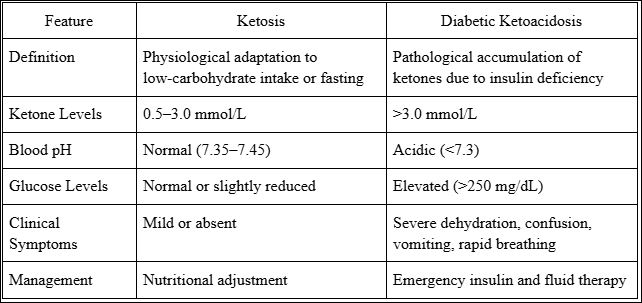
Pathological acidosis is confirmed by a diabetic ketoacidosis test, which differentiates it from benign ketosis during fasting or in a ketogenic diet.
Clinical interpretation and management implications.
The DKA test does not exist in a vacuum; its results need to be applied in a clinical setting. DKA is confirmed by elevated levels of ketones in blood, low levels of bicarbonate and acidosis. The next steps involve:
- Fluid Replacement - Replaces intravascular volume and eliminates dehydration.
- Insulin Intake - Reduces the production of ketones and decreases glucose.
- Correction of Electrolytes, particularly potassium, to avoid cardiac arrhythmias.
- Monitoring and Follow-Up - Repeat blood tests of ketones are used to monitor the recovery of metabolism.
Frequent blood ketone monitoring is also useful in the long-term management, as it helps to avoid relapse when one is being infected, on a lapse in insulin intake, or during a disruption of the diet.
Is it possible to have a person without diabetes to develop Ketoacidosis?
Yes, but uncommon, ketoacidosis might also present itself in non-diabetic persons, given certain circumstances. Other non-diabetic causes are alcoholic ketoacidosis, starvation ketoacidosis and lactation ketoacidosis. The similarity between these conditions is that they have high levels of ketones in the blood and acidosis of the metabolism, but are differentiated by the amount of glucose in the body and the mechanism.
There is, however, a difference in that glucose levels are usually normal or low in non-diabetic ketoacidosis, and high in DKA. An acetone blood test or a blood test for ketones can be done to differentiate these conditions and initiate the right treatment.
Also Read: Diabetes Itching – Causes & Remedies
Diabetic Ketoacidosis Prevention by Diabetic Tests
Frequent surveillance is an element of DKA prevention. Strategies include:
- Carrying out a blood test of ketones in case of illness, infection, or stress.
- Monitoring blood ketones at a glucose level of greater than 250mg/dL.
- Patient education on the time to use the DKA test at home.
- Regulating the insulin levels in accordance with illnesses or changing diets.
Early detection and treatment, noticing such precursors as fatigue, vomiting, or rapid breathing and receiving immediate attention.
Early testing and interpretation can be useful in decreasing the number of hospitalisations and mortality caused by DKA.
Also Read: 6 Best Exercises Diabetic Patients Can Do At Home
Key Takeaways
- The diabetic ketoacidosis test is necessary to diagnose and treat one of the most severe complications of diabetes.
- It entails blood tests and urine samples to identify an excessive amount of ketones and to verify metabolic acidosis.
- Knowledge of the range of blood ketone levels will aid in the differentiation of normal metabolism, ketosis and DKA.
- Frequent blood ketone analysis is essential when one is sick, under stress or has poor glucose control.
- Ketoacidosis can develop both in diabetic and non-diabetic patients, but the mechanisms are different.
- Diagnosis and treatment of DKA will avoid hospitalisation, and the results will be better in terms of survival.